Thursday, October 21, 2010

Small sinks

I continue in my mission to expose the European propensity to place the faucet in impossible locations (e.g. impossible to fully clean your hands without touching the sink... or at all sometimes!).

This one is the worst.  It's practically running down the side!  And why is the sink sideways?  Just uncool. (From a pizza joint in Soho, London)


Seriously Sweden?  I'm sure you can get a larger faucet than that for such a MASSIVE sink!

These are not frites

Today after work (in NY!) I walked past a food truck labelled "Frites and Meat."  Har har.  Despite the lame rhyme, though, I was suddenly struck with a desire for some nice Belgian style frites, so I ordered some fries with a side of spicy chili aioli.  I cannot describe the sheer disappointment when my fries came back not thick, hot, crispy and chunky, but think and crispy and slightly cooled (argh!).  Now, I will be the first to defend thing American-style fries, but sometimes you want the chunky ones, especially when that's what's been (subconsciously) advertised!  Fortunately they were tasty and the aioli was very nice, but I couldn't really get over the fact that I wanted something more, well, Belgian.  The Dutch photocopied news clippings that covered the cone holding the fries only made the disappointment more bitter.  A picture of the offending fries below:


I also observed today that I had stopped automatically letting women off of the lifts ahead of me.  I wonder why that is?  Certainly it seems expected here, but the English are polite, so I doubt something about the national culture rubbed off on me.  Perhaps it was just not expected in London (highly possible, if you see how people behave on the Tube) or at my company?

Sunday, August 15, 2010

Language Barriers 2

The friend who disparaged my pancakes (as I did hers) has pointed out that I failed to mention my third understanding of the word pronounced "marquee" and sometimes spelled "marquis": a nobleman of the finest tradition, dedicated to helping oppressed peoples throw off the shackles of foreign dictatorship; often bearing the name "de Lafayette."

And I misspelled "caricature."

Saturday, August 14, 2010

Language Barriers

I find that the linguistic troubles that beset me in England normally have to do with food.  Some of these I have come to take in stride, but they are nevertheless non-trivial. For my most recent (re-)discoveries:
  • Coffee here is either "black," or "white."  White, as you may have guessed, is with milk.  Fine, that makes some sense.  What doesn't make sense is when you order an americano, defined as espresso with water, and they ask you if you want it white.  Huh?  I mean, I suppose you could want some milk in it, but then that's why they have little jugs of milk at the coffee shop.  And if I say I want it white, do you only add milk, and no water?  Isn't that a latte without the froth?  Or do you add water and then the milk?  For that matter, why are you ever asking if you want coffee black or white at a take-away coffee shop with jugs of milk by the napkins?  Shouldn't the customer just add the milk themselves?  Why bother having the jugs if you're going to do it?  I find this strange.  Especially with americanos.
  • Pancakes are not pan-cakes here.  They are neither crepes (thin, large, light, delicate) or American pancakes (fat, fluffy, yummy) but rather some sad caricature of food: thin, chewy, dense, and rubbery.  When confronted with the logic that cakes are fluffy, and therefore so pancakes should be, an English friend said that pancakes shouldn't double as coasters; I countered that they shouldn't double as placemats.  Keep in mind that this is not unique to a single chef, but rather has been my experience with many different pancake... sculptors?
  • Something that occurs during the period of time is said to be "at" the weekend.  How very strange... to me, "at" the weekend implies that it would be on the cusp (e.g. Friday night) and wouldn't make much sense at that.  "On" the weekend is likewise roundly rejected here.  At least we can agree on "over," and "during."
  • "Fort" and "fought" have the same pronunciation.  This created some issues when being read a poem.  My Canadian housemate and I couldn't understand what was being said!  "Fort shy?  That does not make sense."  This is not so much a problem as it is interesting, because I had previously identified words that sound the same in American English but are distinguished in Received Pronunciation, as the standard "Queen's English" is known.
  • A marquee bar is a bar in a tent.  While I understand that marquee is a type of tent, the first image that popped into mind was of a bar under a neon sign saying "bar!"  Apparently that usage isn't known here...

Thursday, June 10, 2010

Zoomio… ehhhh!

I have the sensation that I am going very, very quickly.  My seat buzzes with the speed and I glance outside the window.  Outside it’s dark, gloomy, filthy; somewhere I would never choose to be, and I am glad to have some good country music to keep myself occupied.  But that’s only because I’m in a tunnel on the high-speed train returning to Rome from Florence, and soon I will re-emerge into the glorious Tuscan sunshine, to look upon a rolling landscape sprinkled with farms and vineyards; a stunning image of green, fields, stone cottages and tractors, framed by Cyprus trees and leaping mountains in the distance.  Closer-to, a town is perched upon a small plateau fronted by 50 foot cliffs.  I have no complaints, especially given the stark contrast between the Italian countryside and the chaotic, filthy, but equally spectacular cities.  It is my fourth day in Italy after as many nights.  The first two were spent in Rome, followed by a day and a half in Florence, which is quite different.

So how was it?  Well, Rome was incredible.  If you have just one city to visit in Europe, I would seriously consider putting it on your short-list.  The Renaissance-period architecture and monuments are unbelievable – perhaps the most spectacular edifices of marble I have ever seen.  Around corners or through narrow passageways, and you emerge into grand squares, with some historical monument or church (oh look… the pantheon!). Fountains flow from numerous squares, surrounded by locals enjoying their evening gelato.  And what delicious gelato they have.  I have had no fewer than 6 cups of gelato, and every one was delicious.  Perhaps the best was from a place that claims to also be in New York, but I have seen no evidence other than their cups [EDIT: It’s called Della Palma, I discovered on my 7th cup].  Most of the food has, in fact, been delicious.  The pasta is tasty - though, I will have to admit, really no better than a good Italian restaurant in New York City - and the toppings on my grab and go pizza slices were so fresh that the simplicity didn’t matter; just some chunks of fresh tomato, basil and unmelted cheese.  Mmm.  Next time I go into a pizzeria I will definitely consider similar, which I normally pass over for more - let’s say puréed - pizzas.  Another slice (loosely used, as they are actually cut from a large rectangle and sold by weight) had some of the most flavorful pesto I have ever tasted, with some cream and whole walnuts.  I won’t pretend that any of it was healthy.

As for the sights, the pantheon was incredible, St. Peter’s Basilica was glorious (rivaling or surpassing the Hagia Sofia in Istanbul) and the Coliseum was falling apart… but amazing still.  The various squares and famous fountains were all well worth seeing too.  Unfortunately we did not have a chance to go to the Vatican museum, which was closed on Sunday, but I intend to return today to see the Sistine Chapel.

Our accommodations, however, really could have used some work.  We arrived at the main train station in Rome, and following the directions to our hostel, we walked down some shady, graffiti-covered streets.  And then some more.  And then some more.  And past a cat woman feeding 10 feral cats.  And down an empty block with just a few people standing outside of doors, but that was otherwise shut down.  We walked up and down this block a few times, as it allegedly contained our hostel, but did not see any signs.  Finally, one of the loitering men spoke up: “are you looking for the hostel?”  I was reminded of illegal watch sellers in China (“psst, fake Rolex?”) which did not precisely bode well.  He took us into the building, which had a dirty, grimy lobby area, and was obviously residential.  At this point, if I had been apartment shopping, I would not only have walked away but found a new real estate agent.  So it goes.  Up a single flight of stairs and we were at our room.  Apparently, this “hostel” only had two rooms, and we had the private one.  Of course, it only had one bed (my friend and I had requested two).  Oh well.  Surprisingly though, it had a computer, a decent bathroom with shower, and very high ceilings, so it may perhaps be the nicest illegal hostel in Italy.  Nevertheless, it did not feel clean, simply because of the surroundings. 

Not a great introduction to Rome, and it was hardly enhanced by our adventure to the San Lorenzo area where the university students go out.  Every street was likewise covered by graffiti (as, really, are many streets in Rome), and eventually we arrived in a collection of streets full of euro-chic students in dark attire (how many leather jackets?  sooo many).  The main attraction appeared to be square full of students cradling beers and smoking (it is Europe) so we grabbed pizza and gelato, walked around, and ended up settling down an people-watching.  Certainly different from the normal Rome experience, and I’m glad we did it.  Of course, much of the Rome experience involves people-watching, but setting was different :).  Strangely, despite the grime of Rome, most streets have a few constantly-flowing water fountains dumping water into the drains.  You can either fill a bottle with its spring-fed aqueduct-transported water, or cover the spout and receive an upward squirt to drink.  Delicious, and free!

And Florence? Florence is not nearly so grand as Rome is, but has an amazing collection of art, both in churches and in museums.  I saw Michelangelo’s David, the tombs of Machiavelli and Galileo, and the Duomo, which is not only a very striking church in green and white stone, but also the first dome built in modern times (as the art was lost after the fall of the Roman Empire).  There is also an interesting bridge covered with shopkeepers and their stalls, and a fantastic view of all the red-brick roofs from a hill on the south side of town. Unfortunately, the town is quite touristy, which means that there aren’t many restaurants that aren’t frequented by foreigners.  The result was that you simply had to judge which ones the Italians favored and go with them.  The best story to illustrate this involves three women from - by the sound of it - New Jersey, who decided that the menu was “too fishy” and “too touristy.”  They promptly got up and left the restaurant.  I remarked that they were probably looking at the fish menu, and that they were being rather rude.  At this point, we heard some fairly familiar voices behind us.  Having decided that the restaurant we were at was too touristy, they went the restaurant next door.  In the same touristy square.  Nice.  Like tourists go to one of the restaurants and not the other?  My amusement was heightened even further when the people to replace them at the seats next to us were Italian.  

Unfortunately, there isn’t a lot to see at night in Florence, but this also presents an opportunity – you can hop on a commuter train to Pisa, to see how not to build a tower.  Ari (my travelling companion) and I hopped on a train after our self-tour of Florence to go see the tower, have pizza (because you have to have pizza in Pisa: it alliterates!), and meet some new friends (which we duly did when two Swedes invited us to dine with them).

Update:  I am now on the plane to London, and managed to see the Sistine Chapel.  The Vatican Museum took me about an hour to get through just walking (there’s really only one way to go, except for detours that loop back upon the main path) with minimal pauses.  The artwork in the museum was amazing, particularly, for me, the pristine Roman sculptures.  The Sistine Chapel is huge and an obvious masterpiece, but I was a bit underwhelmed.  The problem is that the paintings are all so far away, you can only vaguely identify them, and can’t really enjoy the mastery of the paintings.  Instead, you get the bigger picture which is, no offence to Michaelangelo, a bit cluttered (consisting, after all, of so many different scenes).  I was struck by the same sense that I had at the Louvre when viewing the Mona Lisa, which is not only relatively small, but protected by about a foot of glass, situated 10 feet from the closest viewing point, and surrounded by hordes of tourists taking photos of the painting far worse than what they would find on the Louvre’s website.  Faced with this scene, I chose to take, instead, a picture of the tourists.  I suppose I should write about my journey to Paris soon!

On another, interesting cultural note, I think I saw a mother breast feeding her 6 year old, standing child (I obviously didn’t look closely out of deference).  I wonder how common this is in other cultures?  It reminds me of a scene from The Last Emperor

Wednesday, June 2, 2010

P.S. About Brownies

By the way, though it was expected I would not be able to find candy canes, I was also completely unable to locate peppermints, which I figured could substitute on the topping.  No matter, I think the brownies are probably better without them, but I'm constantly amazed by the random things you can't buy in London...

A May Bank Holiday Weekend

So, this past weekend was a holiday weekend, coinciding with Memorial Day in the US.  In England, it was "Late Spring Bank Holiday" (but interestingly not in Scotland or Northern Ireland... the UK has far less national identity than, say, a Canadian trout, which will be found popping out of the water just to tell you that Shania Twain is a Canadian, don't you know... but I digress; more about that another time).  So, having a three day weekend, I perfected relaxation.  On Saturday, I made myself fluffy pancakes (highly recommended: http://allrecipes.com/Recipe/Fluffy-Pancakes-2/Detail.aspx), went to get two tickets for O.A.R., an amazing band that is popular among college students, and is well-known enough to sell out Madison Square Garden.  I missed them last time they were here because I didn't want to pay an online booking fee and kept forgetting to go to the box office, until they sold out the week before.  As you have probably guessed, they are not nearly so popular here, which has proven to be a problem - all of my friends who know them are busy studying or are away for the weekend, and nobody else knows who they are!  And this band can sell out The Garden!  Anyway, I then met up with some people to see Prince of Persia: The Sands of Time, and enjoyed it, as atrocious as it was.  I was probably swayed by having played 1.5 of the "Sands of Time" themed video games while my apartment in college was addicted to them.

On Sunday, I went to Islington - which is one of my favorite areas of London because it's not only pretty but the restaurants are actually local and unique instead of the same old bland high street chains (I am not opposed to chains per say, simply bland ones!) - and got coffee and cake with my friend Eunice at Fig & Olive (http://www.yelp.co.uk/biz/fig-and-olive-london).  My cheesecake and her gooseberry (http://en.wikipedia.org/wiki/Gooseberry) tart were both delicious, and we enjoyed them through a narrow passageway leading to a quiet park surrounded by victorian townhouses (as are common in nice areas of London... though they are not often public).  We had actually intended to get food at the Islington Market, but we were unable to find it (or get into it), despite seeing a sign.  However, as a result of our wandering, we did walk past Emma Watson, whose phone number I got.  Okay, I didn't get her phone number, but I did get a photo with her:


Okay, so in case you have no sense of humor, that photograph is fake, so I didn't get a photo with her, but I did walk past her a second time after dropping of my friend at the tube.  At which point I said to her, "look, I don't know who you are, or why you're following me, but it's completely inappropriate!"  Except that I didn't, but I did chuckle to myself thinking about it.  I then walked back through the north part of London, through Camden Town (an area with a big market and the box office I had gone to on Saturday) and through Regent's park, which is beautiful, and has a tasty looking sausage hut that reminded me I had yet to eat lunch, and had no cash.  Oops!  So I went back home, and bought corned beef to try to make a corned beef sandwich (preferably on rye with swiss and sauerkraut! oooooh reuben....), but lo and behold, corned beef here is not, I repeat not the same thing that it is in the US.  It's gross.  And it's dry.  And most of it comes in tins.  Like spam. EW.  I will not be buying it again (I bought an untinned kind, don't worry!), though the horseradish and mustard certainly made it more palatable.  There is something similar to corned beef called salt beef that is sold in food halls and at some specialty sandwich shops (normally emblazoned, aptly, with the words "Salt" and "Beef"), which is good, but still not the same. 

On Monday, I went on a quest to make peppermint brownies (http://allrecipes.com/Recipe/Ghirardelli-Peppermint-Brownies/Detail.aspx).  This quest had, in fact, begun months before, when I realized the difficulty of obtaining 100% unsweetened chocolate in London.  So I had Sara bring me some from New York.  Thanks Sara!  Since then, it has appeared in the (regular, but nice) grocery store near me, which is the only place I have seen it (I think), and it comes in a big 180g hunk (as opposed to easily-melted bars) for about $5.50 for 4 oz (compare this to Ghirardelli for $3.50, or Baker's brand for $1.70 in the US).  Anyway, the chocolate problem solved, I thought the rest would be easy.  Alas, it took me three grocery stores to find real peppermint extract (and two to find fake peppermint flavo(u)ring), which left me near Whole Foods, the grace of London.  I was never a big Whole Foods person in New York, since I didn't see the point (I lived near a great normal grocery store) but in London it allows me to get imported things for less than anywhere else (if they are uncommon), which on Monday meant pepper jelly and Peanut Butter & Co. brand Peanut Butter (direct from NYC).  Of course, they also have fresh peanut butter in-store made by grinding peanuts, so perhaps the PB &Co was a poor choice.  Anyway, I finally made it back home and made the mint brownies.  I had to substitute the Ghirardelli-squares-as-icing with after-eight-mints-as-icing which was probably a poor choice given the chewy nature of After Eights (http://en.wikipedia.org/wiki/After_Eight) compared to Ghirardelli squares (which are creamy inside), and definitely made the brownies quite sweet.  But still delicious.  Highly recommended recipe.  Top that off with a delicious dinner of corn (I have it a lot now that it's in season), which is amazing and delicious, and imported (which I suppose isn't so good).  It comes, pathetically, in little plastic sealed packets and the cobs are about half the length of a proper American ear of corn, despite some of it coming from the US (I think we get shipped the dregs).  Oh well, it's still delicious with butter, salt and pepper.  MMMMMmmmmm


Monday, May 17, 2010

What's in a bus?

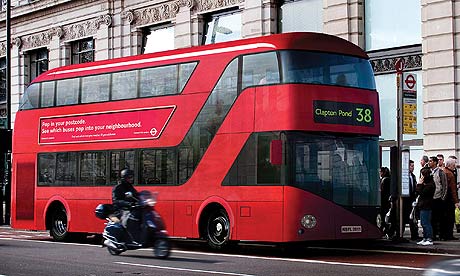
In the news today was a bit about the mayor unveiling his new routemaster bus design (below next to the old)

Apparently, Londoners are so enamored of their now-retired original routemaster that the mayor promised to replace the now-common bendy-buses with new double-decker routemasters that would be anew "21st century icon."  So, with all of the development costs, the first 5 will cost a whopping £7.8 million pounds (because of development costs).  And here's what you get over a normal double decker bus:

  • An additional door at the back of the bus
  • Two staircases instead of one
  • Twice the marginal cost per bus (£300k instead of £150k)
  • 40% greater fuel efficiency
I know what you're thinking: "40% fuel efficiency increase could save a lot of  money and the environment".  But you'd be wrong, because what you really need to compare to are the normal hybrid bendy buses.  Here's what you get compared to one of them:

  • 15% greater fuel efficiency
  • half the capacity
  • somewhat iconic double decker look that is only marginally different from a normal double decker bus
Yes, that's right, you halve the capacity.  So, great, it goes 15% further per unit of fuel, but with half the people.  For those of you keeping track, that makes it 42.5% less efficient at peak times.  What a waste of money.  All because the mayor doesn't like the bending buses on London's narrow streets.  But guess what? They seem to work.

Sunday, May 16, 2010

Cooking in London

Whenever I decide to bake any food in London (and it's almost always bake, since I don't seem to "cook" much), there is always some ingredient I can't get in the local grocery store.  This seems to happen without fail, such that I always plan my baking for a period when I know I can go ingredient-hunting.  So, for example, when I've wanted to make:

  • Chocolate pecan pie (highly recommended recipe, basically just a chocolate pie with pecans - http://allrecipes.com/Recipe/Chocolate-Pecan-Pie-III/Detail.aspx), I couldn't get Corn Syrup
  • Chocolate chip cookies, I couldn't get chocolate chips
  • Brownies from scratch, I couldn't get baking chocolate
  • Gingerbread cookies (also highly recommended - http://allrecipes.com/Recipe/Big-Soft-Ginger-Cookies/Detail.aspx - but add more ginger), I couldn't get molasses
  • Pumpkin pie, I couldn't get pumpkin
  • Bacon, I couldn't get American-style (that is to say not big, and thick and gross) bacon (and honestly, I still haven't made it, but I know where to get it now!)
  • Wings (haven't made these yet either, remember, I bake!) I couldn't get Frank's Red Hot.
Frustratingly, these are all things you can get at any American grocery store year round!  And now I've finally learned where to get all of these things in London (though Pumpkin is available only in November).  In case you are ever here and need to bake something, the best places to get these ingredients, in approximate price order:
  1. Whole Foods in Kensingon, where there are loads of American imports of packaged foods, including Peanut Butter & Co. peanut butter from NYC and Boylan's soda from NJ, yum! (http://www.boylanbottling.com/) They also have many speciality foods that are hard to find despite being UK made (like chilli jelly for my crackers, cream cheese and pepper jelly snacks), and perhaps some American-style meat cuts, though I haven't looked (and they can't be, or perhaps just aren't, imported from North America).
  2. Selfridge's Food Department, where I was able to find Tabasco Pepper Jelly (delicious!) and Marshmallow Fluff (which I don't normally get but was unable to resist) and baking chocolate (I think).
  3. Partridges in Sloane Square, where I saw American-Style Oscar Mayer bacon from... Spain.  Whatever, it'll work.  Also there were numerous cereals and Mac & Cheese, which you can't get here.
  4. Random little American Food Stores on various side streets (like one near Notting Hill Gate on the way to Shepherd's Bush on the right off of Holland Park Road) that sell outrageously priced sodas and chocolate chip bags.
You can also, now, find chocolate chips in teensy weensy 100g bags at large Tesco supermarkets, but they work out to be about the same as bags in the states are (despite being teensy weensy chocolate chips as well).

Finally, there's the Stateside Candy Co. online (http://www.americansweets.co.uk/), which is the only place I have found my beloved Wheat Thins (but have yet to order them).

I have yet, however, to find a place to buy an electric griddle other than a £50 number from Amazon ($75!!!!).  This despite checking all of the major department stores and specialty kitchen shops I could find.  Apparently, Brits don't like griddling things (the fact that "pancakes" are giant crepe-like things here probably hurts the cause).

So, the main reason I wrote this post was that I made gingerbread cookies today, and you should too.  I've posted the recipe above, and it was fabulous.  I'll let you know about how my attempts to make molasses-brown sugar-balsamic vinegar mustard work out (to copy delicious Fox More Than A Mustard from Vermont - http://www.sugarbushfarm.com/Products.aspx?pn_deptid=157)

Cookies:

Weekend Exploring

It's been a long time since I've written, so I've decided to chronicle my weekend - interesting or not!

Despite having lived here for eight and a half months, I feel that I do not have a good conceptual grasp of London.  I understand the area around me in Kensington and Hammersmith (the borough in which I live and the one next to it), and I feel that I have a good general idea of what is where in central London (which in fact consists of a number of boroughs, some with rather long tendrils that reach into the heart of town), but I don't feel that I really understand any of those places.  And when it comes to the outer boroughs, well, I really have no idea.  (As I think I've explained before, "London" generally refers to Greater London which actually consists of 32 boroughs and the City of London, which is only about a square mile in size - almost all of the governmental buildings you probably associate with London are actually in the City of Westminster which is in fact a city, but also a borough in Greater London.  It is quite clear that a "city" in England does not mean the same thing that it does in most of the United States, where it implies certain duties performed by the municipal government).

Anyway, with that in mind, I decided to go exploring on Saturday.  My first stop was at the Shepherd's Bush Market near my house, which was unexciting - a market with numerous clothing, Arab food, and kitchenware stalls.  Next, I hopped on a bus to the "town" of Elephant and Castle.   I say town, because most of London is in fact lots of little communities.  So my borough of Kensington has its own high street (equivalent to the American main street) with the same shops that you'd find on most other high streets (adjusted for the quality of the neighborhood).  The same is true of most other areas in London.  This is unlike, say, New York, where the shops are spread out on the major avenues and major side streets, but no area in Manhattan has a "main street" to speak of.  This becomes less true in the outer boroughs of New York, where only one main avenue will have the stores, but even then there are far more local shops than you would find in London, and the thinking is not quite so linear.

I should pause here and explain my understanding of London architecture.  Most things can be categorized according to the following tree:

  • Nice
    • Town-like - one or more of:
      • Old red brick
      • Old Victorian
      • Old Tudor
      • Old stone churches
    • City-like - one or more of:
      • Big grand, oldish (think Westminster Palace/Big Ben or buildings like those in Washington DC)
      • New, grand, stone (similar to new Federal buildings)
      • New modern
      • Old stone churches
  • Ugly
    • Both of:
      • Ugly yellow brick
      • Ugly modern concrete blocks.
There doesn't really seem to be much deviation from this tree, and my impression of most of the outer areas I encounter is that they fall under the Ugly category.

So, continuing.  My bus ride took me along my street past Holland Park and through Notting Hill (Mostly town-like Victorian, with a few ugly new buildings thrown in at Notting Hill's major intersection), nothing exciting to see there.  Then down Hyde Park, around a corner, and down toward Victoria Station.  Again, nothing I hadn't seen before.  And then, around a corner, past a park, and out into the square in front of the new Supreme Court of the United Kingdom (most exciting - a separated legislature and judiciary! As a side note, there was a lot of fear about the new court beginning to exercise judicial review.  Admittedly, the lack of a written constitution means that judicial review would be, literally, arbitrary, but nevertheless the concept makes some sense). Here, finally was something exciting.  A bunch of protesters!  At first, I was rather confused, because the main banner proclaiming "capitalism doesn't work!" was backed by others asking for "peace now!" and I could not see how they were strictly related, until I realized that there were, in fact, at least three separate groups - peace protesters ("bring our troops home NOW"), communists (hammer and sickle flag, "capitalism doesn't work!") and people protesting for a "fair votes now " (some form of proportionate voting, rather than the current plurality system).  A photo:

After crossing over the bridge just by Big Ben, the bus went under a railway (leading to Waterloo station, no doubt - there are so many train stations in London!) and promptly entered the "ugly" phase, and remained in that state all of the way to Elephant and Castle.  The high street in Elephant and Castle was nothing to write home about, except for the minor excitement of an oriental grocery store selling, among other tasty Asian goods, root beer, which is very difficult to get here.  Not only was it selling root beer, but it was only £0.79 per can, imported from Singapore and the US (two varieties).  Very nice.  A can of A&W root beer and a box of chocolate pandas -


- and I was on another bus back to Kensington via a different route (remember, it was all about exploring!).  I massed through two more neighborhoods and a green that I had previously heard were nice (and I was in fact a fan, in large part because they were hilly) - Clapham Commons (the neighborhood and green) and Clapham Junction, where, allegedly, a lot of Australian people live (and the evidence was quite strong, judging by the "barbie" restaurants and tiki bars along the street.  Here I changed for another bus to Sloane Square, with the landscape changing back to "ugly" before I hit the river-front area, and ended up in Chelsea (beautiful red brick).  Along the Chelsea part of the journey, which took me up King Street (the Chelsea high street) I decided that Chelsea was one of my favorite parts of London.  Only after I alighted at the end of the bus line in Sloane Square, did I realize that my favorite part of Chelsea had been the part at the very end of the journey, and that this, stereotypically, is where Americans live.  I think that part of it might be cultural (there is much more red brick in the US than there is here, so we may be drawn to it, and there is a store stocking American imported goods right next to the Square) but a lot of it is probably also money-related.  Despite the fact that there are more Americans in England than any other English speaking nationals other than the Irish, I encounter far more Aussies, Kiwis and Canadians than I do yanks.  I can only assume, therefore, than they're all executives!  Seems reasonable.  Anyway, executives are the only ones who could live in Sloane Square.  Very swanky, and very expensive.

After popping into the gourmet food store containing the American imports (I was more interested in seeing their mustard selection, embarrassingly) I headed up toward Mayfair, another swanky part of town that I wanted to get a better grasp of.  I wandered around the area, which contains both the Saudi and (much larger but uglier) American embassies.  The US embassy is on Grosvenor Square, which is a beautiful residential (and diplomatic) area surrounded by townhouses, John Adams's house, and which is also the site of Adlai Stevenson's heart attack.  The nearby streets contain shopping, and restaurants in equal number to, as far as I could tell, members-only clubs and restaurants, such as Cipriani London.  Nothing exciting, but all of it (near the square) beautiful.  Further out in Mayfair and it's still very posh (to be British about it) but a few ugly modern buildings have been thrown in for good measure.

All in all, a nice day exploring, even if it only solidified my sense that there aren't many neighborhoods of London I need to go see still.  I'd still like to go to Greenwich though, and to explore Hampstead and St. John's Wood (both of which I've found lovely when I've been previously).

Friday, April 9, 2010

A Savage Nation

There are many things you may "know" about England; some of them are correct: scones and clotted cream are great, people speak with fantastic accents, it rains a lot, London is a beautiful city, the Queen is old; some of them are not correct: people are classier (than the US), most people speak with fantastic accents, bathrooms are sensibly warm, the tube is great.

What you (and I) did not know, but is demonstrably true, is that Brits (or perhaps just Englanders, or, barring that, just Londoners) will fight for a bargain.  Literally.  Last weekend American Apparel - the rather offensively-run American retailer - had a rummage sale in a slightly shabby part of London known as Brick Lane.  2000 people attended and, as you wouldn't expect, since it's just clothing, that there was a riot, which injured 10 police officers.  Of course.  Why wouldn't there be?  If you're viewing this on email, click here to see the main post, and the video: http://thirdcultureworld.blogspot.com/

Sunday, March 28, 2010

Two tap sinks

I read this post on another young expat’s blog, and I had to send a link to it.  Basically, two-tap sinks are, inexplicably, extraordinarily common here.  I think it’s because people don’t like change.  Not only that, but you can’t turn off the water supply under the sink without an Allen key!  How ridiculous!  I’d note that the writer didn’t know that American sinks allow you to turn off the supply with knobs, but I left a comment to allow her to continue loathing them unconditionally :)

http://notfromaroundhere.wordpress.com/2010/03/02/two-tap-sinks-revisited

Thursday, February 11, 2010

Panoramas

Hi everybody!  I’m sorry that I’ve been so remiss with posting, so I’ve decided to start anew by posting a few panoramas from some of my most recent trips – Banff with the family, the Alps (Switzerland & France), and Oslo.  Enjoy!  I’m sorry to say that I don’t really have any great photos from Paris, since it was dreary weather, but I will post the decent ones (from all of my trips) later.

If you are getting this in an email, you may have to go to the actual website (http://thirdcultureworld.blogspot.com) to view these.

Sunshine Village, in Banff:

2

Chamonix:

8

Oslo:

21

Sunday, November 8, 2009

Malta? Where’s that?

I am presently squeezed into a window seat a few miles above France on my way back to London from the tiny micro-nation of Malta.  For those who do not know (and I am unashamed to admit that I did not just a few weeks ago), Malta is a former UK island colony in the middle of the Mediterranean that obtained independence in 1964.  Prior to its membership in the empire it served a brief period under French rule (during which the British were called for “help”) and a long period of independence.  Its principal cities were built by the knights who acquired Malta in the 1500s and defended it during the “great siege,” which despite my having never heard of it, I gather is an event of importance unmatched in history.  Without it, Malta would have been Turkish, and then who knows what would have happened?  I spent just under 48 hours in the nation, which seems either just right or a tad too long. 

I arrived on Friday afternoon after a leisurely morning journey to the airport (my other option was a torturous early-morning journey to a much more remote airport, which did not seem worth it), and decided to take the scenic route into town.  I hopped on the bus (the only only service, plied by authentic 1950s equipment) to the capital city of Valletta (if a nation of 380 sq km can be said to have a capital city).  My ride (cost €0.47) took me through narrow streets and hilly neighborhoods, and I felt that it allowed me to really see where the locals live.  I arrived in Valletta and after a bit of aimless wandering that found me in a hilltop park overlooking a sailboat-filled bay whipped out my mobile phone and used the GPS to scout my way down some very steep, stepped streets and underpasses to the bottom of the hill and the ferry to Sliema, where my hotel was situated.  A short wait and chat on the phone with some people in the States and the ferry arrived.  After a quick journey (€0.97) I found myself on the shore of a much flatter “town” full of hotels and tourist destinations, and I set off for the approximately 10 minute walk to the hotel.  I managed to get my room key (I was meeting my friend) and found myself in a massive, recently-constructed two-bedroom apartment with floor-to-ceiling slide-away windows giving way to a balcony overlooking the bay. Very nice.

While I didn’t manage to see all of the sites, I feel like my day trip the next morning to the country’s second-largest island, Gozo, consumed rather more time than it needed. 

While I still maintain a proud record of having never booked an organized sight-seeing tour (I do not count my overnight boat trip on Halong bay in Vietnam, since it was less sightseeing and more yachting), my travel companion did sign us up for one.  Fortunately it was free of any guides, so we were merely given a brief introduction to every stop by our driver, and were then free to wander around.  Unfortunately, he made the grave error of signing up for the included meal, which doubled the price of the journey but halved its value.  Of course you do not know whether you will have the chance to eat somewhere else, but as it turned out our wretched included sustenance (did you expect otherwise) was in a small seaside village that included much better food for less money.  No worries though, you live and learn!  In this case we learned: ask if there will be other restaurants near where we will be getting lunch.

So, what did we see?  The highlights of the trip included such wonders as:

  • A church that Pop John Paul II visited.  Apparently built in the 30s, it was a church.  It had an apse and a nave and some stained glass windows, along with some lovely photos of the pope looking popely.
  • A folklore museum.  I didn’t go in, because I don’t care much about folklore.  Instead, I walked around the small, deserted hilltop village we were in and bought some stamps, a coke, and some mint chocolate.  The stamps were the largest stamps I have ever seen.  The coke came in a tall can, and the mint chocolate was very tasty.  Sadly the chocolate bore the Aero brand popular here in Europe, which signifies that half of the chocolate has been replaced by – you guessed it – air.  Allegedly this gives it a cool “bubbly” taste, but I suspect that the marketers wake up every morning, log into their bank accounts, and have a hearty laugh about how they were able to convince people to buy half the chocolate for the same price.
  • Capers.  Apparently they are famous capers.  Our driver pointed at them out of the window.
  • Quarries.  Also spotted through the windows of the van.
  • Bamboo.  Not only spotted through the window, but also present near where we struggled through lunch.
  • Fungus rock.  A small rocky island (about 200 feet across) that is the only place where a particular fungus grows.  It was unclear whether this fungus grows elsewhere in the world.  It was used by the knights to create medicine, but we were not informed of any modern usage.
  • Some beautiful cliffs and an archway over the ocean.  In fairness to fungus rock, these were all in the same place, and the complete effect was really quite beautiful.
  • The world’s oldest freestanding human-made structure.  It looked like a disintegrated pile of rocks arranged into walls, but apparently was used as a temple.  Probably.  It was built around 3500 BC.  Probably. It was old, and unremarkable.
  • The city of Victoria.  Other than the ocean-side at fungus rock, this was the only thing I found worth visiting.  The city was a beautiful, hilly town overlooking the entire island.  It was topped by a citadel (which was really a cathedral) and a great viewing wall, and included a quaint square filled with coffee shops, as well as another church. 

Upon returning to the island of Malta on a mixed pedestrian and vehicular ferry and riding back to our hotel, we went to a well-known local restaurant for some local Maltese food.  Apparently Maltese food is distinguished by a local fish and rabbit, and as I had consumed rabbit on the previous day (in a delicious rabbit ravioli appetizer) I opted for the local fish as the main course in my set menu, which was great. 

Today, Sunday, we hopped on an ancient local bus to travel around the bay to Valletta, where we wandered around the town and had a nice cup of coffee before nipping back to the hotel and on to the airport.

All in all a quaint visit, and while I might take the opportunity for a visit if it is offered to you, I wouldn’t make a destination of it or travel very far to get there, especially if you haven’t yet seen the (sorry Malta) much more interesting destinations nearby in Europe.  The one thing I would probably have done differently is that I would have gone to see the city of M’dina (after Medina, meaning “city” in Arabic) that predated the crusaders of the 1500s.  Of course, I’m sure that there are many similar cities in the world, and I’m sure that I will see something similar in the future, if I have not already.

Friday, October 30, 2009

Fooooootbaaaalll!

Now, with a title like “Fooooootbaaaalll!” you probably think I’m going to talk about soccer.  But nope, you’re wrong, I’m going to talk about good old American Gridiron!  Last Sunday, you see, the New England Patriots played a regular season game against the Tampa Bay Buccaneers at Wembley Stadium, one of the most expensive stadia ever built and the largest stadium in the world with every seat covered.  Needless to say, I attended.  At first I was hesitant since I was not able to convince anybody else to attend with me, and because tickets were awfully expensive, but in the end I decided that I didn’t want to miss out on any opportunities while I am living here.

I arrived at the Wembley Park tube station to find a rather spectacular walkway jammed with people on the way to the stadium, which loomed in the distance.  I purchased a ticket from a scalper on the way (after shuddering a bit at the price, which was expensive before the 20% markup – but remembering that it’s not every day one gets to see the Patriots play in England) and made my way to the stadium.  My seats were right behind the goal post and close to the field (so really not that great for watching the action) but I had a great view of the entire stadium. 

This, it turns out, was my first professional football game, and despite the foreign setting, I was not disappointed.  Tampa Bay was the “home” team, and they had everything you expect from an NFL extravaganza.  There were cheerleaders, a pre-game show, fireworks when Tampa Bay ran onto the field, and flags for all of us to wave to cheer them on.  In the end, I did not come away disappointed.

The only really “English” experiences were the national anthem and the waves.  As for the anthem, nobody sang along to Tony Braxton’s rendition of The Star Spangled Banner, which felt like a popular dance mix compared to God Save the Queen, which was sung very slowly and operatically, and had 90,000 people struggling for breath while still finishing each word before the singer.  Not really very good.  The waves, as in movements of standing people around the stadium, were fantastic because they were so much more energetic than the ones I have witnessed in the states.  As the wave would approach your quarter of the stadium you would start murmuring, growing into a very loud “oooooo” sound before you stood up and "oooo”ed at your loudest!  It was great fun because you could not only see the wave but also hear it make its way around the stadium.

As for the football game, I’m disappointed to say that I have seen better games played by Ivy League universities (who are awful at football).  The problem was that Tampa Bay didn’t really fight back.  The first interception was in the second play of the game, and resulted in a patriots touchdown!  No complaints about the victors, but it would have been nice to have an exciting game, not one that finished by running out the clock with the score an insurmountable 35-7.

A great experience nevertheless, and it furthered my resolve to show up to “novice” practice for a local American football team this Sunday. They claim that these practices are for people who have never played before, so I figure that if people who have never played the sport can join, than I, who have at least played some pick-up games, should be welcome to tag along.  I doubt they will ever let me play (they won the UK championships last year), but hopefully it will be a good way to get some exercise, make friends, and learn how to play football better!

Why can’t I get anything?

“A what?” the customer service agent asks.

“A pie tin,” I respond.  I find myself making hand gestures normally reserved for countries where I do not speak the local language natively. 

A few seconds pass before I am directed to an aisle that contains flat metal dishes, each about the size of a tea saucer.  Alas, they will not do for a pie.

Of all the things that I have found difficult to acquire here, pie tins have surprised me the most.  Surely people bake pies in this country! In fact, I know they do, and yet pie tins were not forthcoming.  Fortunately for our Canadian Thanksgiving celebration happening later that day (a couple of Sundays ago), I was able to find, after checking every home shop and department store at the mall, a couple of cake dishes that were approximately the same size and shape as a pie tin, but with vertical (as opposed to slanted) edges. 

Canadian Thanksgiving was, in all, a great success. We had about 20 people, and we’re looking to follow it up with a great American edition on the 22nd of November.  Now, if only I can find some cranberries!

Universal Healthcare Bills

You’ll have to forgive me for straying from the topic of life in London, but the bills making their way through congress have been really bothering me – not because they are too liberal or too conservative, too expensive or too cheap, but because they don’t achieve their stated objectives.  If you’re not interested in hearing my thoughts on the matter, you should probably just skip this note.  If you are interested, note that I am merely talking about achieving the apparent objectives laid out by members of congress and the administration, that is to say what I would do if I shared their objectives, a discussion for another time that is irrelevant to my complaints.

So, let’s take these as the stated objectives, which as near as I can tell are shared by the leaders of Congress and the President:

1) Universal coverage.  That is to say that every person in the United States should have coverage that meets certain requirements, at the very least, and everyone should be able to afford it.  We’ll call this the base level, and assume that there are no trade-offs allowed (e.g. the government does not want to allow people to have a higher deductible if it means more doctor visits per year).

2) A government-chartered insurer to “compete” with the private insurance companies.  Note again that I am not saying this is a good idea or a bad idea, just that it is a goal.  As an aside, I am not sure whether this can be done honestly, but whenever people say private insurers cannot compete, I keep thinking about the Postal Savings System, which was shut down after private companies bested it in almost every way. I recommend reading up on if you have not heard about it (most people have not).  Health insurance might be different than savings plans though, and it depends on the government-run one being very carefully set up not to have an unfair advantage.

So that’s it for our requirements.  Here’s what I would do:

  • Charter the insurer, and set it up in a way so that it’s run at arms-length.  Set it up as for-profit, not-for-profit, whatever.  Perhaps give it a similar capital structure to a private non-profit insurer, and sell the debt at the same rates to the public, have the government buy the rest, and have the government provide the equity for free.  Perhaps the states will own the equity.  It’s material, but there are undoubtedly different ideas out there.
  • Set up a national marketplace where every plan needs to have a certain minimum level, and each insurer needs to provide a plan of exactly that level.  Which is to say that there will be a homogenous product competing only on price, in addition to products that compete on features.  Require the plans to be open to everyone (at least for initial sign-up and switching between equal or lower coverage levels) and to have the basic-level plan priced the same everywhere in the country.  This is to say that the basic plan from insurer X will always cost $Y, though insurer A may only charge $B.  Any plan above the basic plan can cost different amounts in different places, but no less than the basic plan. Do not allow the states to require anything additional of the basic plans over the federal requirements.  E.g. New York cannot require that all plans cover plastic surgery for men over 40, etc.  For any plans with more than the basic coverage, the states can regulate them further, including the government-chartered plan.

So far, we’re more or less where most of the bills put us, with the exception of the level regulatory playing field I’ve created for the basic health plans.  Now, here’s where I think it becomes different:

  • Provide everyone in the country with a credit of $G at the treasury for their healthcare costs.  $G is the cost of the basic level government run plan.  This is so that everyone can afford insurance, and gets to take their basic dollars where they want them.  Not only that but it’s relatively simple, compared to tax credits, etc.  You just have a database with everyone in it.  Now, allow people to pick their plan.  If they pick their employers plan, their employer can claim that credit, but they do not have to pick their employer’s plan.  If they pick an individual plan, their insurer can claim that credit.  If they pick the chartered plan that organization gets it.  If they pick an individual plan (now, remember, they all have a basic level) that costs less than $G, they will get a check from the for the difference.  Perhaps make it tax-free to encourage low-cost spending.  If they do not pick an insurer assign one to them randomly, or assign them the government one (depending on your political motives).
  • Pay for it.  I don’t really care how.  All we’re doing here is shuffling money around anyway, and creating much larger risk pools.  At the very least, remove the tax deduction for employer-provided benefits.  Everyone will get the same amount tax-free, and they have an incentive to pick really cheap plans (that all provide the basic level) because they will get money back.  Right now, the people with the worst jobs, who are the poorest, have to pay the most for health insurance because they pay with after-tax money.  This is hugely inequitable.  So that will undoubtedly create savings because people might choose to consume less healthcare and select higher paying jobs rather than ones with better healthcare (which they can always add on to in the individual market).  Perhaps add a national sales tax.  Perhaps increase income taxes uniformly by income (1% across the board).  Perhaps increase income taxes non-uniformly by income (10% on the “rich”, 20% extra on the poor).  Perhaps increase taxes uniformly per capita ($G per person).  In any case, it should be completely paid for, but the beauty is that it’s easy.

The reason I state these two objectives is because I think it’s the only way that we will create uniform risk pools with truly universal coverage.  Mandates are complicated and do not address the issue of people who cannot pay, but if you give everyone the basic level of healthcare (through either a private company or the government) then a broadened risk pool is automatic.  Not only that, but it’s less legally suspect.  Requiring people to do something through an income tax surcharge would open the door to requiring people to do anything simply by adding a large tax penalty to an opposing action.  However, the federal government is more than welcome to provide any entitlement it likes – you can’t refuse something that you get automatically, and it’s not forcing you to do anything (except your taxes, but you already have to pay them).

Any thoughts?  I’d love to hear what people think.  The problem I have with the current bills is that they are over-complicated, still leave inequities (not in terms of coverage, but in terms of special treatment – people with generous company coverage are much better off  in terms of their tax-adjusted consumption levels than people with an income increased by the cost of that same coverage), and don’t achieve their stated goal of covering everyone.

I know the cost of this plan would be high, but the higher taxes would be rebated directly to individuals, meaning that they would still be in the hands of the public to be spent by the public, essentially just requiring them to consume a particular good.  I could guess that such a tax would not have the same impact on economic growth as others would. E.g. imagine a tax that you got back as a visa gift card that you can also get cash from at ATMs.  Would this impact economic growth?  Probably not because you can use it as cash or in lieu of your credit card.

Friday, October 16, 2009

A moving update

In the sense of driving.  After practicing my left-side stick-shift driving uneventfully on a couple of trips to Ikea, I found out that apparently the English practical driving test has a few rather stringent requirements.  The situation, as explained to me by my friend, is that I “know how to drive, but now [I] have to learn to take the test.” The problem is that they are very particular about a few things that I do not do naturally:

  1. You are required to downshift while braking in every circumstance.  I understand that this is safer than just braking because you can accelerate away, but worse for the clutch.
  2. You must use the handbrake for starting almost every time.  While this is probably safer and better for the car when you are on a hill, I do not find it natural and normally only do it on steep inclines.
  3. They require you to check the mirrors constantly and in a particular order, especially while braking.  Normally when I’m braking I look at the relevant mirrors (rear-view, then the right and/or left ones depending on where I am on a road), but they want you to (apparently) go in a set order, even if you are driving on a narrow, one-lane, one-way road.

I have been advised that I should really take a few lessons before my test, which is not a bad idea, especially considering the other problem: despite being able to drive without restriction, for the test I need to have a car with special insurance and plates.  This makes no sense because it means that I am allowed to terrorize the populace while driving on my own, but that when I am supervised by a government employee, they need to be warned.  However, despite this warning the licensing authorities are unyielding, and I thus need to hire an instructor to take me to my test on the day.  As a result of all of these extra costs and hassles (£31 theory test, £75 practical test, £20/hr driving lessons for practice and the test) I decided that I’ll hold off until I know how long I’m going to be here.  The important thing is that I have a UK ID now, so I can use it of proof of address and identity.  Meanwhile, I can make sure that I do all of the tourist attractions that require driving within my first 12 months.  If I decide to take my test I will just need to take a few lessons and give myself a three month buffer (though I don’t see why I should need to drive) to have everything scheduled. The irony, of course, is that I will be legally able to drive in most countries other than the one of my residence.  Very bizarre.

On a happier note, my trips to Ikea mean that my room is now quite tidy, though still undecorated.  On my first trip I got some photo frames and a bed-side table, but discovered that they were not only a really bad color for the room, but that I didn’t need the frames anyway, since my housemates purchased many in Asia so that we could hang photos in matching frames all over the house.  After returning the frames and exchange the table, everything looks great!  Now I just need to find those frames, and get some photos printed. I have to say that I was awfully tempted by the New York City photos at Ikea, so undoubtedly I will have to make some city prints in addition to those of the family variety.

These are a few American things

Last weekend I went to see Inherit the Wind, which I had always thought was a quintessential part of every American education.  After all, I saw it myself in 7th or 8th grade, and I lived in (very recently) China.  Alas, neither of the Americans that I told about going had seen the film, and none of the people I was going with (one Canadian, one English) had either, so I think I was the only one who knew the whole story.  Kevin Spacey played the lawyer for the defendant brilliantly.  Yes, Kevin Spacey.  He’s the artistic director at the Old Vic Theatre, where he normally stays behind the scenes while bringing classic 20th century theater, often American, back to the stage.  The rest of the characters were all fantastic, and I only had reason to suspect that any of them were faking American accents on a few occasions.  My favorite character was the reporter from Baltimore, who had the characteristic film and theater accent for reporters in the early 20th century, which I have never heard spoken naturally.  I wonder if television producers made it up, or if it was in fact just the way people altered their voices to speak on the radio (as anyone who has been involved with radio knows many speakers still do).  Overall a great production, and I actually felt the desire to give a standing ovation, though I am often the one person in a crowded orchestra section who is still sitting, because I believe that our highest form of performance praise should be reserved for the highest quality of performance.  Interestingly, in this case, I was the only person standing until the second curtain call for the two leads, at which point about 1/3 of the audience stood.  Very strange.  I figure that either people are more inspired by musicals (my normal fare) or that there is something about the production that touches the American psyche, in the same way that images of Mao do not affect westerns as they do the Chinese.  That or it just made me feel happy to hear so many American accents :). 

That wasn’t the only American adventure this week.  I’ve also done a bit of grocery hunting for my housemate’s Canadian Thanksgiving party (we’re having both – a bit of competition!) and discovered that, horribly, canned pumpkin is not in stock anywhere (“coming soon,” they said, if they were a specialty store, “what?” they said otherwise), and worse, that many Canadians have never have had pumpkin pie.  To have lived and not had pumpkin pie… is it to have lived at all?  In an equally disturbing trend, it seems that chocolate chips are not quite so ubiquitous as they are in America.  Of all the things I thought would be hard to find, chocolate chips were not on the list.  It turns out that if a grocery store (fortunately not specialty store) has them, they come in a container about the size of a spice jar, with enough chocolate chips for 2 cookies.  I guess people don’t make cookies very much!  I may try to make some of my favorite recipe, if I can find the ingredients, but given my difficulty making pancakes (I had to try three times with English ingredients before getting them about right) it could be a disaster.

So you can’t make an exception?

I did not know the word “busker” before I moved to England (and indeed it does not appear in my spell-check dictionary) but apparently it’s a street performer.  In any case, I was in the underground station on the way home today and there was a man in a wheelchair playing a violin.  Wanting to give him something but having no change (only a £5 note) I went to the ticket counter and asked for some change.  “We don’t give change,” the man said, pushing back the note. “I want to give the busker some money,” I said, sliding it back again. “What?” Here’s the note again. Back and forth it goes.  “The performer, I want to give him some money.”  “Sorry.” "Why do you have a performer if I can’t give him change?” Nothing but a shrug.  I take my note and go, extremely disappointed.

On the subject of subway performers, I find it very strange that they do not vary them very much here.  At the station where I interchange on the way to work, the same Caribbean guitarist is playing every day.  Surely they would all benefit from a rotation?  I’m not likely to give money to the exact same performer playing the exact same songs every day!  Definitely not a zero-sum game.  On the way home, the station near my office does switch it up, which is nice.  On some days there is not a performer but there is a handicapped cleaning employee who is whistling very loudly.  While at first I wasn’t sure what to make of it, I eventually decided that it made me quite happy.  If this gentleman is unable to support himself and needs government money anyway, why not allow him to have a job?  He certainly seems happy and can feel like he is a productive member of society.  Meanwhile, he is probably quite helpful to the staff in the underground, and brings a bit of happiness to my life.  Seems like a win-win situation to me, as long as other people who do not receive government aid are not shut out of those jobs (e.g. these jobs are created as additional hiring out-of-budget).