Monday, May 17, 2010

What's in a bus?

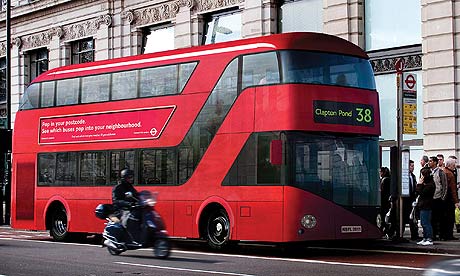
In the news today was a bit about the mayor unveiling his new routemaster bus design (below next to the old)

Apparently, Londoners are so enamored of their now-retired original routemaster that the mayor promised to replace the now-common bendy-buses with new double-decker routemasters that would be anew "21st century icon."  So, with all of the development costs, the first 5 will cost a whopping £7.8 million pounds (because of development costs).  And here's what you get over a normal double decker bus:

  • An additional door at the back of the bus
  • Two staircases instead of one
  • Twice the marginal cost per bus (£300k instead of £150k)
  • 40% greater fuel efficiency
I know what you're thinking: "40% fuel efficiency increase could save a lot of  money and the environment".  But you'd be wrong, because what you really need to compare to are the normal hybrid bendy buses.  Here's what you get compared to one of them:

  • 15% greater fuel efficiency
  • half the capacity
  • somewhat iconic double decker look that is only marginally different from a normal double decker bus
Yes, that's right, you halve the capacity.  So, great, it goes 15% further per unit of fuel, but with half the people.  For those of you keeping track, that makes it 42.5% less efficient at peak times.  What a waste of money.  All because the mayor doesn't like the bending buses on London's narrow streets.  But guess what? They seem to work.

Sunday, May 16, 2010

Cooking in London

Whenever I decide to bake any food in London (and it's almost always bake, since I don't seem to "cook" much), there is always some ingredient I can't get in the local grocery store.  This seems to happen without fail, such that I always plan my baking for a period when I know I can go ingredient-hunting.  So, for example, when I've wanted to make:

  • Chocolate pecan pie (highly recommended recipe, basically just a chocolate pie with pecans - http://allrecipes.com/Recipe/Chocolate-Pecan-Pie-III/Detail.aspx), I couldn't get Corn Syrup
  • Chocolate chip cookies, I couldn't get chocolate chips
  • Brownies from scratch, I couldn't get baking chocolate
  • Gingerbread cookies (also highly recommended - http://allrecipes.com/Recipe/Big-Soft-Ginger-Cookies/Detail.aspx - but add more ginger), I couldn't get molasses
  • Pumpkin pie, I couldn't get pumpkin
  • Bacon, I couldn't get American-style (that is to say not big, and thick and gross) bacon (and honestly, I still haven't made it, but I know where to get it now!)
  • Wings (haven't made these yet either, remember, I bake!) I couldn't get Frank's Red Hot.
Frustratingly, these are all things you can get at any American grocery store year round!  And now I've finally learned where to get all of these things in London (though Pumpkin is available only in November).  In case you are ever here and need to bake something, the best places to get these ingredients, in approximate price order:
  1. Whole Foods in Kensingon, where there are loads of American imports of packaged foods, including Peanut Butter & Co. peanut butter from NYC and Boylan's soda from NJ, yum! (http://www.boylanbottling.com/) They also have many speciality foods that are hard to find despite being UK made (like chilli jelly for my crackers, cream cheese and pepper jelly snacks), and perhaps some American-style meat cuts, though I haven't looked (and they can't be, or perhaps just aren't, imported from North America).
  2. Selfridge's Food Department, where I was able to find Tabasco Pepper Jelly (delicious!) and Marshmallow Fluff (which I don't normally get but was unable to resist) and baking chocolate (I think).
  3. Partridges in Sloane Square, where I saw American-Style Oscar Mayer bacon from... Spain.  Whatever, it'll work.  Also there were numerous cereals and Mac & Cheese, which you can't get here.
  4. Random little American Food Stores on various side streets (like one near Notting Hill Gate on the way to Shepherd's Bush on the right off of Holland Park Road) that sell outrageously priced sodas and chocolate chip bags.
You can also, now, find chocolate chips in teensy weensy 100g bags at large Tesco supermarkets, but they work out to be about the same as bags in the states are (despite being teensy weensy chocolate chips as well).

Finally, there's the Stateside Candy Co. online (http://www.americansweets.co.uk/), which is the only place I have found my beloved Wheat Thins (but have yet to order them).

I have yet, however, to find a place to buy an electric griddle other than a £50 number from Amazon ($75!!!!).  This despite checking all of the major department stores and specialty kitchen shops I could find.  Apparently, Brits don't like griddling things (the fact that "pancakes" are giant crepe-like things here probably hurts the cause).

So, the main reason I wrote this post was that I made gingerbread cookies today, and you should too.  I've posted the recipe above, and it was fabulous.  I'll let you know about how my attempts to make molasses-brown sugar-balsamic vinegar mustard work out (to copy delicious Fox More Than A Mustard from Vermont - http://www.sugarbushfarm.com/Products.aspx?pn_deptid=157)

Cookies:

Weekend Exploring

It's been a long time since I've written, so I've decided to chronicle my weekend - interesting or not!

Despite having lived here for eight and a half months, I feel that I do not have a good conceptual grasp of London.  I understand the area around me in Kensington and Hammersmith (the borough in which I live and the one next to it), and I feel that I have a good general idea of what is where in central London (which in fact consists of a number of boroughs, some with rather long tendrils that reach into the heart of town), but I don't feel that I really understand any of those places.  And when it comes to the outer boroughs, well, I really have no idea.  (As I think I've explained before, "London" generally refers to Greater London which actually consists of 32 boroughs and the City of London, which is only about a square mile in size - almost all of the governmental buildings you probably associate with London are actually in the City of Westminster which is in fact a city, but also a borough in Greater London.  It is quite clear that a "city" in England does not mean the same thing that it does in most of the United States, where it implies certain duties performed by the municipal government).

Anyway, with that in mind, I decided to go exploring on Saturday.  My first stop was at the Shepherd's Bush Market near my house, which was unexciting - a market with numerous clothing, Arab food, and kitchenware stalls.  Next, I hopped on a bus to the "town" of Elephant and Castle.   I say town, because most of London is in fact lots of little communities.  So my borough of Kensington has its own high street (equivalent to the American main street) with the same shops that you'd find on most other high streets (adjusted for the quality of the neighborhood).  The same is true of most other areas in London.  This is unlike, say, New York, where the shops are spread out on the major avenues and major side streets, but no area in Manhattan has a "main street" to speak of.  This becomes less true in the outer boroughs of New York, where only one main avenue will have the stores, but even then there are far more local shops than you would find in London, and the thinking is not quite so linear.

I should pause here and explain my understanding of London architecture.  Most things can be categorized according to the following tree:

  • Nice
    • Town-like - one or more of:
      • Old red brick
      • Old Victorian
      • Old Tudor
      • Old stone churches
    • City-like - one or more of:
      • Big grand, oldish (think Westminster Palace/Big Ben or buildings like those in Washington DC)
      • New, grand, stone (similar to new Federal buildings)
      • New modern
      • Old stone churches
  • Ugly
    • Both of:
      • Ugly yellow brick
      • Ugly modern concrete blocks.
There doesn't really seem to be much deviation from this tree, and my impression of most of the outer areas I encounter is that they fall under the Ugly category.

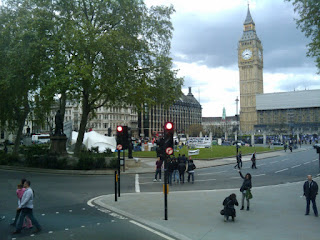
So, continuing.  My bus ride took me along my street past Holland Park and through Notting Hill (Mostly town-like Victorian, with a few ugly new buildings thrown in at Notting Hill's major intersection), nothing exciting to see there.  Then down Hyde Park, around a corner, and down toward Victoria Station.  Again, nothing I hadn't seen before.  And then, around a corner, past a park, and out into the square in front of the new Supreme Court of the United Kingdom (most exciting - a separated legislature and judiciary! As a side note, there was a lot of fear about the new court beginning to exercise judicial review.  Admittedly, the lack of a written constitution means that judicial review would be, literally, arbitrary, but nevertheless the concept makes some sense). Here, finally was something exciting.  A bunch of protesters!  At first, I was rather confused, because the main banner proclaiming "capitalism doesn't work!" was backed by others asking for "peace now!" and I could not see how they were strictly related, until I realized that there were, in fact, at least three separate groups - peace protesters ("bring our troops home NOW"), communists (hammer and sickle flag, "capitalism doesn't work!") and people protesting for a "fair votes now " (some form of proportionate voting, rather than the current plurality system).  A photo:
After crossing over the bridge just by Big Ben, the bus went under a railway (leading to Waterloo station, no doubt - there are so many train stations in London!) and promptly entered the "ugly" phase, and remained in that state all of the way to Elephant and Castle.  The high street in Elephant and Castle was nothing to write home about, except for the minor excitement of an oriental grocery store selling, among other tasty Asian goods, root beer, which is very difficult to get here.  Not only was it selling root beer, but it was only £0.79 per can, imported from Singapore and the US (two varieties).  Very nice.  A can of A&W root beer and a box of chocolate pandas -


- and I was on another bus back to Kensington via a different route (remember, it was all about exploring!).  I massed through two more neighborhoods and a green that I had previously heard were nice (and I was in fact a fan, in large part because they were hilly) - Clapham Commons (the neighborhood and green) and Clapham Junction, where, allegedly, a lot of Australian people live (and the evidence was quite strong, judging by the "barbie" restaurants and tiki bars along the street.  Here I changed for another bus to Sloane Square, with the landscape changing back to "ugly" before I hit the river-front area, and ended up in Chelsea (beautiful red brick).  Along the Chelsea part of the journey, which took me up King Street (the Chelsea high street) I decided that Chelsea was one of my favorite parts of London.  Only after I alighted at the end of the bus line in Sloane Square, did I realize that my favorite part of Chelsea had been the part at the very end of the journey, and that this, stereotypically, is where Americans live.  I think that part of it might be cultural (there is much more red brick in the US than there is here, so we may be drawn to it, and there is a store stocking American imported goods right next to the Square) but a lot of it is probably also money-related.  Despite the fact that there are more Americans in England than any other English speaking nationals other than the Irish, I encounter far more Aussies, Kiwis and Canadians than I do yanks.  I can only assume, therefore, than they're all executives!  Seems reasonable.  Anyway, executives are the only ones who could live in Sloane Square.  Very swanky, and very expensive.

After popping into the gourmet food store containing the American imports (I was more interested in seeing their mustard selection, embarrassingly) I headed up toward Mayfair, another swanky part of town that I wanted to get a better grasp of.  I wandered around the area, which contains both the Saudi and (much larger but uglier) American embassies.  The US embassy is on Grosvenor Square, which is a beautiful residential (and diplomatic) area surrounded by townhouses, John Adams's house, and which is also the site of Adlai Stevenson's heart attack.  The nearby streets contain shopping, and restaurants in equal number to, as far as I could tell, members-only clubs and restaurants, such as Cipriani London.  Nothing exciting, but all of it (near the square) beautiful.  Further out in Mayfair and it's still very posh (to be British about it) but a few ugly modern buildings have been thrown in for good measure.

All in all, a nice day exploring, even if it only solidified my sense that there aren't many neighborhoods of London I need to go see still.  I'd still like to go to Greenwich though, and to explore Hampstead and St. John's Wood (both of which I've found lovely when I've been previously).

Friday, April 9, 2010

A Savage Nation

There are many things you may "know" about England; some of them are correct: scones and clotted cream are great, people speak with fantastic accents, it rains a lot, London is a beautiful city, the Queen is old; some of them are not correct: people are classier (than the US), most people speak with fantastic accents, bathrooms are sensibly warm, the tube is great.

What you (and I) did not know, but is demonstrably true, is that Brits (or perhaps just Englanders, or, barring that, just Londoners) will fight for a bargain.  Literally.  Last weekend American Apparel - the rather offensively-run American retailer - had a rummage sale in a slightly shabby part of London known as Brick Lane.  2000 people attended and, as you wouldn't expect, since it's just clothing, that there was a riot, which injured 10 police officers.  Of course.  Why wouldn't there be?  If you're viewing this on email, click here to see the main post, and the video: http://thirdcultureworld.blogspot.com/

Sunday, March 28, 2010

Two tap sinks

I read this post on another young expat’s blog, and I had to send a link to it.  Basically, two-tap sinks are, inexplicably, extraordinarily common here.  I think it’s because people don’t like change.  Not only that, but you can’t turn off the water supply under the sink without an Allen key!  How ridiculous!  I’d note that the writer didn’t know that American sinks allow you to turn off the supply with knobs, but I left a comment to allow her to continue loathing them unconditionally :)

http://notfromaroundhere.wordpress.com/2010/03/02/two-tap-sinks-revisited

Thursday, February 11, 2010

Panoramas

Hi everybody!  I’m sorry that I’ve been so remiss with posting, so I’ve decided to start anew by posting a few panoramas from some of my most recent trips – Banff with the family, the Alps (Switzerland & France), and Oslo.  Enjoy!  I’m sorry to say that I don’t really have any great photos from Paris, since it was dreary weather, but I will post the decent ones (from all of my trips) later.

If you are getting this in an email, you may have to go to the actual website (http://thirdcultureworld.blogspot.com) to view these.

Sunshine Village, in Banff:

2

Chamonix:

8

Oslo:

21

Sunday, November 8, 2009

Malta? Where’s that?

I am presently squeezed into a window seat a few miles above France on my way back to London from the tiny micro-nation of Malta.  For those who do not know (and I am unashamed to admit that I did not just a few weeks ago), Malta is a former UK island colony in the middle of the Mediterranean that obtained independence in 1964.  Prior to its membership in the empire it served a brief period under French rule (during which the British were called for “help”) and a long period of independence.  Its principal cities were built by the knights who acquired Malta in the 1500s and defended it during the “great siege,” which despite my having never heard of it, I gather is an event of importance unmatched in history.  Without it, Malta would have been Turkish, and then who knows what would have happened?  I spent just under 48 hours in the nation, which seems either just right or a tad too long. 

I arrived on Friday afternoon after a leisurely morning journey to the airport (my other option was a torturous early-morning journey to a much more remote airport, which did not seem worth it), and decided to take the scenic route into town.  I hopped on the bus (the only only service, plied by authentic 1950s equipment) to the capital city of Valletta (if a nation of 380 sq km can be said to have a capital city).  My ride (cost €0.47) took me through narrow streets and hilly neighborhoods, and I felt that it allowed me to really see where the locals live.  I arrived in Valletta and after a bit of aimless wandering that found me in a hilltop park overlooking a sailboat-filled bay whipped out my mobile phone and used the GPS to scout my way down some very steep, stepped streets and underpasses to the bottom of the hill and the ferry to Sliema, where my hotel was situated.  A short wait and chat on the phone with some people in the States and the ferry arrived.  After a quick journey (€0.97) I found myself on the shore of a much flatter “town” full of hotels and tourist destinations, and I set off for the approximately 10 minute walk to the hotel.  I managed to get my room key (I was meeting my friend) and found myself in a massive, recently-constructed two-bedroom apartment with floor-to-ceiling slide-away windows giving way to a balcony overlooking the bay. Very nice.

While I didn’t manage to see all of the sites, I feel like my day trip the next morning to the country’s second-largest island, Gozo, consumed rather more time than it needed. 

While I still maintain a proud record of having never booked an organized sight-seeing tour (I do not count my overnight boat trip on Halong bay in Vietnam, since it was less sightseeing and more yachting), my travel companion did sign us up for one.  Fortunately it was free of any guides, so we were merely given a brief introduction to every stop by our driver, and were then free to wander around.  Unfortunately, he made the grave error of signing up for the included meal, which doubled the price of the journey but halved its value.  Of course you do not know whether you will have the chance to eat somewhere else, but as it turned out our wretched included sustenance (did you expect otherwise) was in a small seaside village that included much better food for less money.  No worries though, you live and learn!  In this case we learned: ask if there will be other restaurants near where we will be getting lunch.

So, what did we see?  The highlights of the trip included such wonders as:

  • A church that Pop John Paul II visited.  Apparently built in the 30s, it was a church.  It had an apse and a nave and some stained glass windows, along with some lovely photos of the pope looking popely.
  • A folklore museum.  I didn’t go in, because I don’t care much about folklore.  Instead, I walked around the small, deserted hilltop village we were in and bought some stamps, a coke, and some mint chocolate.  The stamps were the largest stamps I have ever seen.  The coke came in a tall can, and the mint chocolate was very tasty.  Sadly the chocolate bore the Aero brand popular here in Europe, which signifies that half of the chocolate has been replaced by – you guessed it – air.  Allegedly this gives it a cool “bubbly” taste, but I suspect that the marketers wake up every morning, log into their bank accounts, and have a hearty laugh about how they were able to convince people to buy half the chocolate for the same price.
  • Capers.  Apparently they are famous capers.  Our driver pointed at them out of the window.
  • Quarries.  Also spotted through the windows of the van.
  • Bamboo.  Not only spotted through the window, but also present near where we struggled through lunch.
  • Fungus rock.  A small rocky island (about 200 feet across) that is the only place where a particular fungus grows.  It was unclear whether this fungus grows elsewhere in the world.  It was used by the knights to create medicine, but we were not informed of any modern usage.
  • Some beautiful cliffs and an archway over the ocean.  In fairness to fungus rock, these were all in the same place, and the complete effect was really quite beautiful.
  • The world’s oldest freestanding human-made structure.  It looked like a disintegrated pile of rocks arranged into walls, but apparently was used as a temple.  Probably.  It was built around 3500 BC.  Probably. It was old, and unremarkable.
  • The city of Victoria.  Other than the ocean-side at fungus rock, this was the only thing I found worth visiting.  The city was a beautiful, hilly town overlooking the entire island.  It was topped by a citadel (which was really a cathedral) and a great viewing wall, and included a quaint square filled with coffee shops, as well as another church. 

Upon returning to the island of Malta on a mixed pedestrian and vehicular ferry and riding back to our hotel, we went to a well-known local restaurant for some local Maltese food.  Apparently Maltese food is distinguished by a local fish and rabbit, and as I had consumed rabbit on the previous day (in a delicious rabbit ravioli appetizer) I opted for the local fish as the main course in my set menu, which was great. 

Today, Sunday, we hopped on an ancient local bus to travel around the bay to Valletta, where we wandered around the town and had a nice cup of coffee before nipping back to the hotel and on to the airport.

All in all a quaint visit, and while I might take the opportunity for a visit if it is offered to you, I wouldn’t make a destination of it or travel very far to get there, especially if you haven’t yet seen the (sorry Malta) much more interesting destinations nearby in Europe.  The one thing I would probably have done differently is that I would have gone to see the city of M’dina (after Medina, meaning “city” in Arabic) that predated the crusaders of the 1500s.  Of course, I’m sure that there are many similar cities in the world, and I’m sure that I will see something similar in the future, if I have not already.